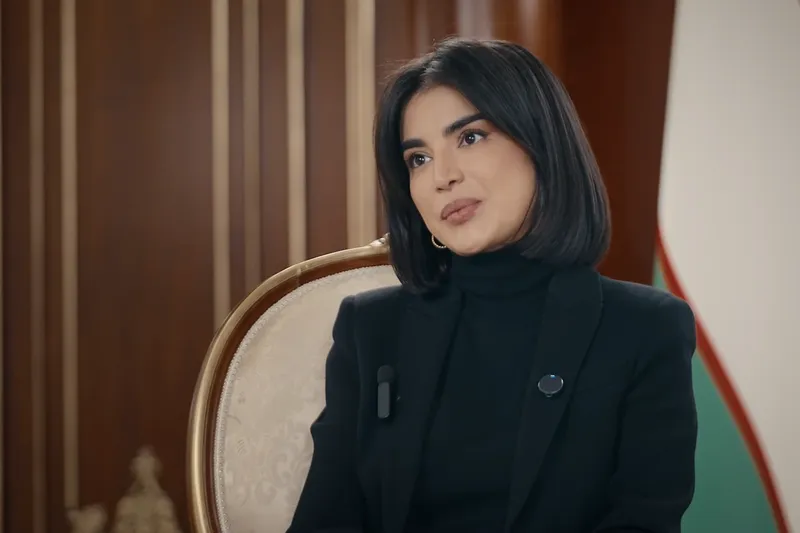
This interview provides an understanding not only about a person or a position, but also about the internal "mechanism" of the changes being carried out in the country.
As Saida Mirziyoyeva emphasized, the main task of the Presidential Administration is to define strategic directions and present a clear roadmap to the executive system. She called the current period an era of reforms, noting that this process requires constant monitoring, unbiased information, and personal responsibility.
The interview also touched upon the working style of the head of state, Shavkat Mirziyoyev. According to Saida Mirziyoyeva's description, the President is a leader who listens to people, approaches ideas with respect, and can develop a team. Reforms yield results not only through administrative rigor but also through adaptability and political wisdom.
The five priority directions facing the Presidential Administration were also clearly listed: water, education, healthcare, the business environment, and the judicial-legal system. In particular, the water issue was noted as one of the most serious challenges for the future. It was clearly stated that reforms in education and healthcare are long-term processes, and expecting quick results is incorrect.
The judicial-legal system was discussed with special emphasis in the interview. According to Saida Mirziyoyeva, without a fair and transparent judicial system, developing business, attracting investment, and strengthening public trust are impossible. The rule of law is the main pillar that binds all reforms.
Speaking about her personal views, Mirziyoyeva described international diplomacy and communication as a direction close to her. According to her, open communication with people, strengthening cooperation, and establishing trusting relationships play an important role in the effectiveness of reforms. The principle that "every person is important" remains a key criterion in state governance.
In the interview, Saida Mirziyoyeva also alluded to the reasons for her appointment as head of the Presidential Administration. She stressed that a system was needed to convey the real situation on the ground to the head of state without concealment. That is, a mechanism capable of seeing not just reports, but the real picture, monitoring execution, and feeling responsibility.
This interview can be perceived not as an ordinary conversation, but also as a signal to society: reforms must be implemented not only through decisions from above, but also through open dialogue, trust, and justice.