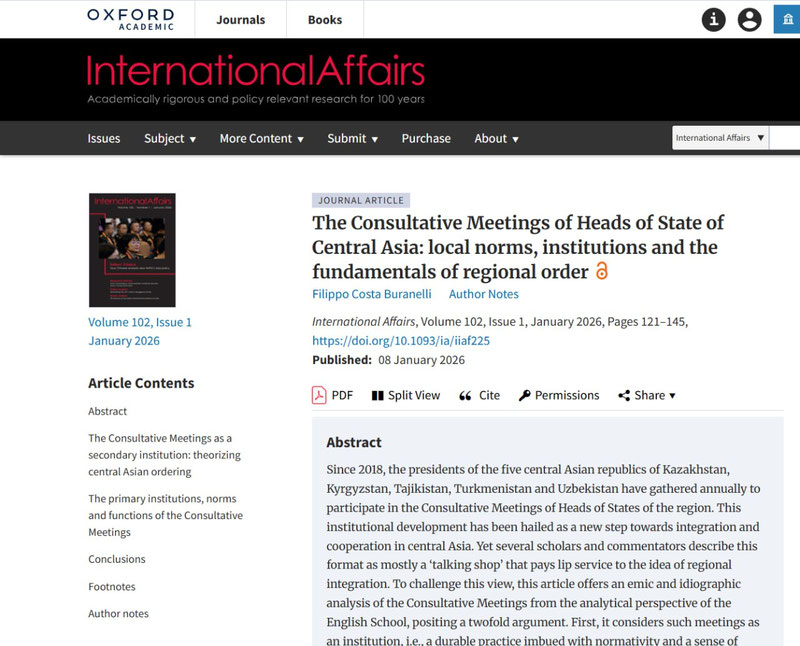
For many years, relations between Central Asian states were primarily in a mode of "rivalry," with various sharpnesses observed. Many regional initiatives until recently also failed for this reason. However, the situation has fundamentally changed. British international relations expert Filippo Costa Buranelli analyzed the reasons for this shift in his new research.
According to the scholar, the new and warm atmosphere in the region is directly linked to the initiative put forward by Uzbekistan's President Shavkat Mirziyoyev from the UN podium in 2017. It was precisely on the basis of this initiative that the "Consultative Meetings of Central Asian State Leaders" began, creating an entirely new order in the region. Now, states are learning not to strive for dominance over each other or to artificially unite, but to bypass problematic issues and engage only in mutually beneficial and sound pragmatic cooperation.
Central Asia is no longer shaping up as a fragmented and mutually rivalrous territory, but as a single center of power based on trust and diplomacy. The Consultative Meetings of state leaders have become the most effective mechanism for resolving regional problems without the interference of external forces, solely on the basis of mutual respect.