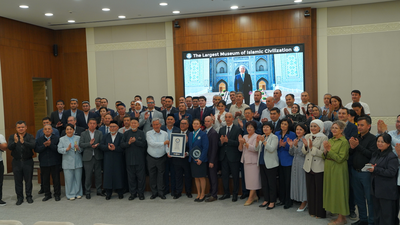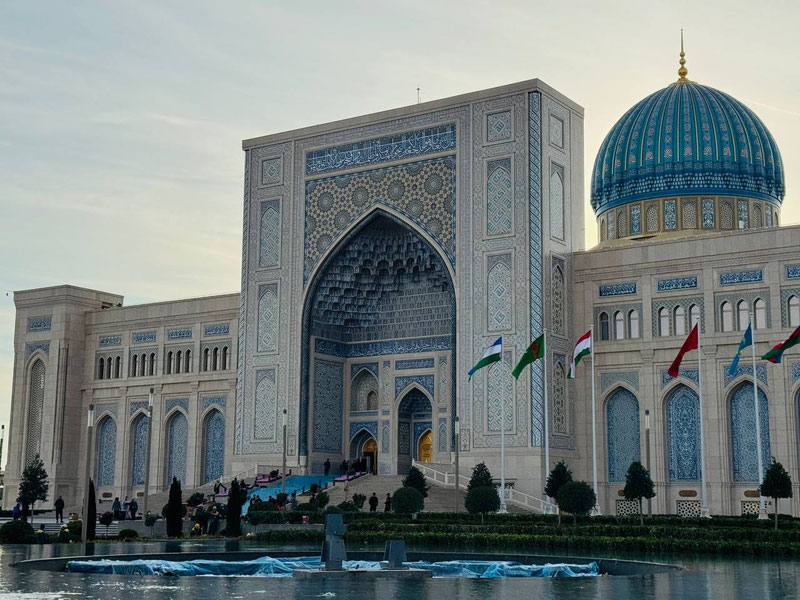
It is noted that the center's museum has been recognized as the "largest museum in the Islamic world." The building was erected on a 10-hectare area within the Hazrati Imam complex in Tashkent. The building consists of three floors, with a length of 161 meters and a width of 118 meters. The height of its dome is 65 meters, and the total usable area exceeds 42,000 square meters.
The center was built on the basis of ancient and national architectural traditions, and it can be entered from four sides through main portals. The portals and external galleries are decorated with Quranic verses and hadiths embodying the themes of knowledge, generosity, humanity, and respect for parents. The first floor houses a museum with an exhibition hall of approximately 8,350 square meters and a conference hall with 550 seats.
The second floor contains a library with a collection of manuscripts, lithographic sources, printed and electronic literature, study rooms, as well as facilities created for international organizations and scientific institutions. A special holographic mapping is installed under the dome, displaying an image of the universe and a composition of stars. This composition was formed based on a star map visible in the Tashkent night sky, and its creation utilized 90 "Swarovski" crystals and over 650 lamps.
The center has collected 114 rare Quran manuscripts related to Uzbekistan, created during various dynasties, alongside the Uthman Mus'haf. Among them are copies belonging to the Samanid, Karakhanid, Ghaznavid, Timurid, Shaybanid, and other periods.
The center has been awarded France's Avicenna Prize, and according to the "Smithsonian Magazine" in the USA, it has been recognized as one of the 10 most anticipated museums in the world for 2026. "Condé Nast Traveler" included it in the list of museums to visit in June 2026, and BBC Travel added it to the list of the world's most awaited museums.